
I recently posted about rules to follow to make a To-Do list that works for you. Now the challenge with a To-Do list is often knowing where to start and in what order to tackle it. So this week, I’m going to share a handy prioritization tool that I’ve found helpful when feeling overwhelmed by too much to do.
This Week’s Habit: Not all tasks are equal – Use a 4-blocker to Prioritize like a Pro
Why does this matter?
We are all faced with way too much stuff to do on a daily basis, at work or at home. We’ve previously talked about the 3 Ds, Delete, Delegate, Defer. But once you’ve trimmed your list using those principles, how do you sort through the remaining tasks to decide which ones to tackle next?
I use a matrix to arrange tasks on an axis from Important to Not Important and Urgent to Not Urgent. I was recently reminded of this technique while reading the magazine Breathe (which I highly recommend!) and it’s a handy little prioritization tool, as shown here:

Quadrant 1: Crises (Important/Urgent)
These are the urgent, high-priority tasks – problems that demand immediate attention or have near-term consequences if not addressed. Think work deadlines, a leaking water pipe, a bill that is due. These should be tackled first.
Quadrant 2: Goals (Important/Not Urgent)
This quadrant is for activities that help you achieve your personal and professional goals. This is the quadrant that puts you first, but paradoxically is often not prioritized correctly! The key to leading an extraordinary life and feeling fulfilled is to spend the majority of your time in this quadrant.This includes activities like exercise, professional development or personal growth. Because those tasks lack immediate deadlines, they often take a backseat to shinier or more pressing matters (the other 3 quadrants). If you’re unsure what belongs here, I’ll talk more about identifying and prioritizing these tasks in a later post.
Quadrant 3: Interruptions (Not Important/Urgent)
Tasks in this quadrant are urgent but not important – at least, not to you. These often come in the form of requests from others that require your time but don’t align with your goals. Be careful not to spend too much time here, as it can prevent you from making progress on what truly matters (Quadrant 2).
Examples include unnecessary meetings, last-minute requests, non-critical emails and messages, social obligations accepted out of guilt.
Delegate these activities when possible and practice saying no when appropriate. Quadrant 3 tasks often disguise themselves as important simply because they matter to someone else.
Quadrant 4: Distractions (Not Important/Not Urgent)
These are the time-wasters – activities that provide little to no value but are tempting, like excessive tv, social media scrolling, procrastination activities etc.. Learn to recognize these and put them in the quadrant they belong to. This quadrant should be the lowest priority – minimize these activities and use them sparingly as rewards or motivation for completing important activities.
To make this concept stick, let’s look at an example.
And what better way to illustrate this than with… drumroll please! Cat activities, of course!
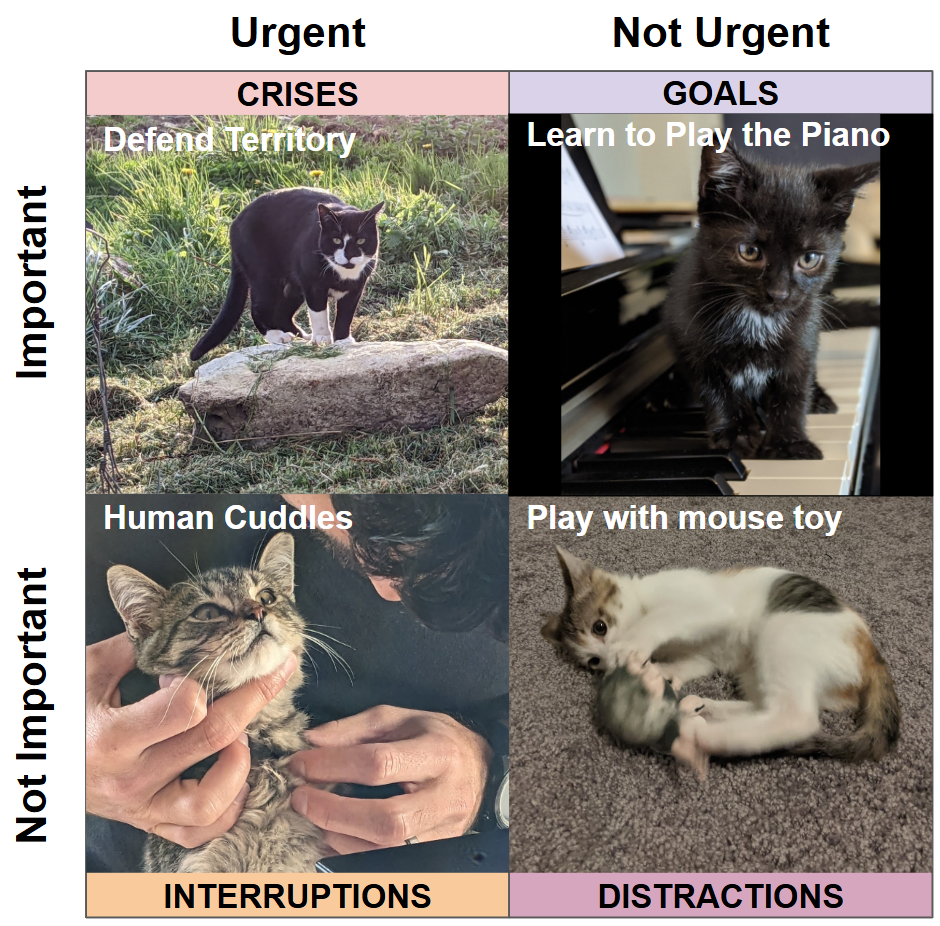
That’s the Important/Urgent Matrix!
Actionable Tip/Challenge:
Tip 1: If you feel overwhelmed, draw a quick 4 blocker
When planning your weekly To-Do list, if you feel overwhelmed, try laying it out in a 4-quadrant format to gain clarity on priorities. Once you’ve exercised this muscle a few times, prioritizing becomes second nature and you likely won’t find the need to do it every week.
- Quadrant 1 → Tackle these first.
- Quadrant 3 → Delegate if possible.
- Quadrant 4 → Minimize distractions.
- Quadrant 2 → Schedule time for these tasks!
Tip 2: Gamify It!
Let’s face it –we’re not robots, and we don’t want to be productive all the time. Use activities in Quadrant 4 as built-in rewards. For example: “if I get through this stack of bills, I get to spend 15 minutes watching funny cat videos.”
Tip 3: Time your distractions
If you choose to engage in Quadrant 4 (Distractions), set a time limit. The intent is not to eliminate your guilty pleasures, but to be intentional so they don’t take you away from what’s important in your life.
Closing Thought:
This week, give the 4-blocker a try. Use it to take control of your time, focus on what truly matters and be intentional about the distractions you allow into your life.
Intentionally Yours,
IE.

 Intentionally Extraordinary
Leave a comment